Industrial robot grippers for integrators
The flexible servo-electric gripper that lets you design simpler, more compact and more profitable robot cells. One jaw configuration. 6–120 mm. No jaw changes. Mechanical hold without power.
- mm clamping range
- 6–120mm clamping range
- force per jaw
- 5 kNforce per jaw
- usable payload
- +8 kgusable payload
This page is for the people who build the cell.
Servo-Flex is engineered around the integrator's reality: fewer references to source, faster commissioning, more payload to play with, and a cell that's easier to sell to the end customer.
Every cell carries the same hidden cost.
The robot is rarely the problem. The gripping strategy is.
Too many grippers
Each part family needs its own tool. Inventory, cost and end-of-arm complexity pile up.
Constant jaw changes
Every changeover means stopping the cell, swapping jaws and re-validating the grip.
Endless setup time
Manual jaw adjustment eats engineering hours and delays commissioning.
Risk of error
Each manual setting is a chance for a mis-grip, a dropped part or a scrapped run.
Lost robot payload
Heavy gripping tools steal kilograms the robot could spend on the actual part.
Replace the rack of tools with a single flexible gripper.
One flexible gripper
A single Servo-Flex covers what used to require a rack of dedicated tools.
One jaw configuration
Keep the same jaws across part families — no swapping, no re-teaching.
6 to 120 mm range
Grip a wide diameter range out of the box, with no manual intervention.
Fewer interventions
Servo-electric control removes air lines and manual tuning from the cell.
More uptime
No changeovers means the robot keeps running — more billable production hours.
Give the robot back its kilograms.
A lighter gripper is not a detail — it's usable payload. Swap a heavy tool for a 4 kg Servo-Flex and the robot can finally lift the part you actually need.
Usable payload recovered
+8 kg
On a 40 kg robot, replacing a 12 kg gripper with a 4 kg Servo-Flex lifts usable payload from 28 kg to 36 kg — heavier parts, same robot, no upsize.
Drops onto the arms you already deploy.
Standard mechanical and electrical interfaces mean Servo-Flex integrates with every major industrial robot and cobot platform.
Two grippers. Every cell covered.
Flexi 100 (2-jaw) and Flexi 150 (3-jaw) — both for industrial robots and cobots, built on the same patented flexible clamping system.
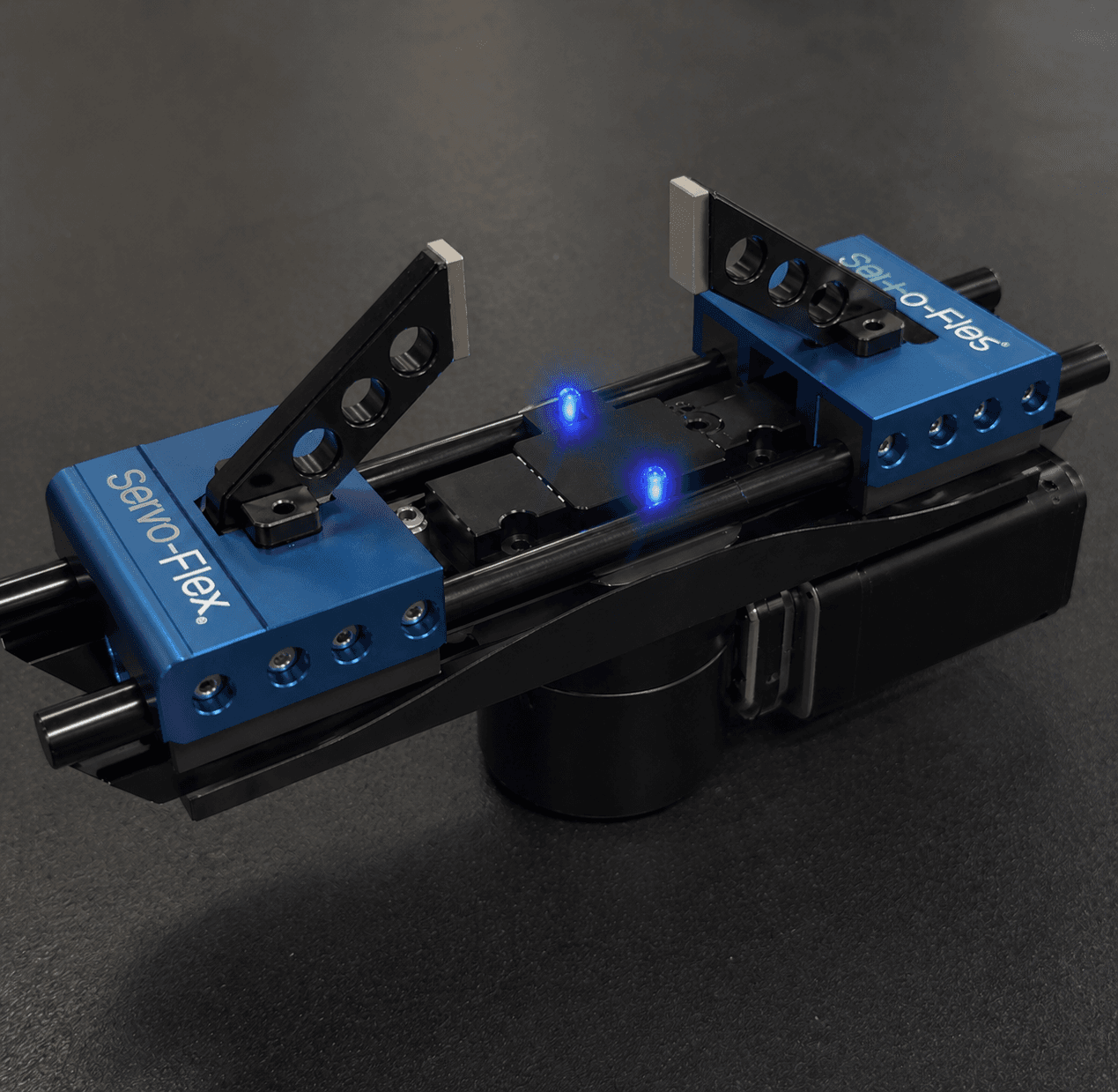
2 jawsFlexi 100
Lightweight 2-jaw gripper for industrial robots and cobots.
- Only 2 kg — preserves cobot payload
- 6–120 mm without manual jaw changes
- 3 adjustable force levels (light / medium / max)
- Patented mechanical clamping system
3 jaws (self-centering)Flexi 150
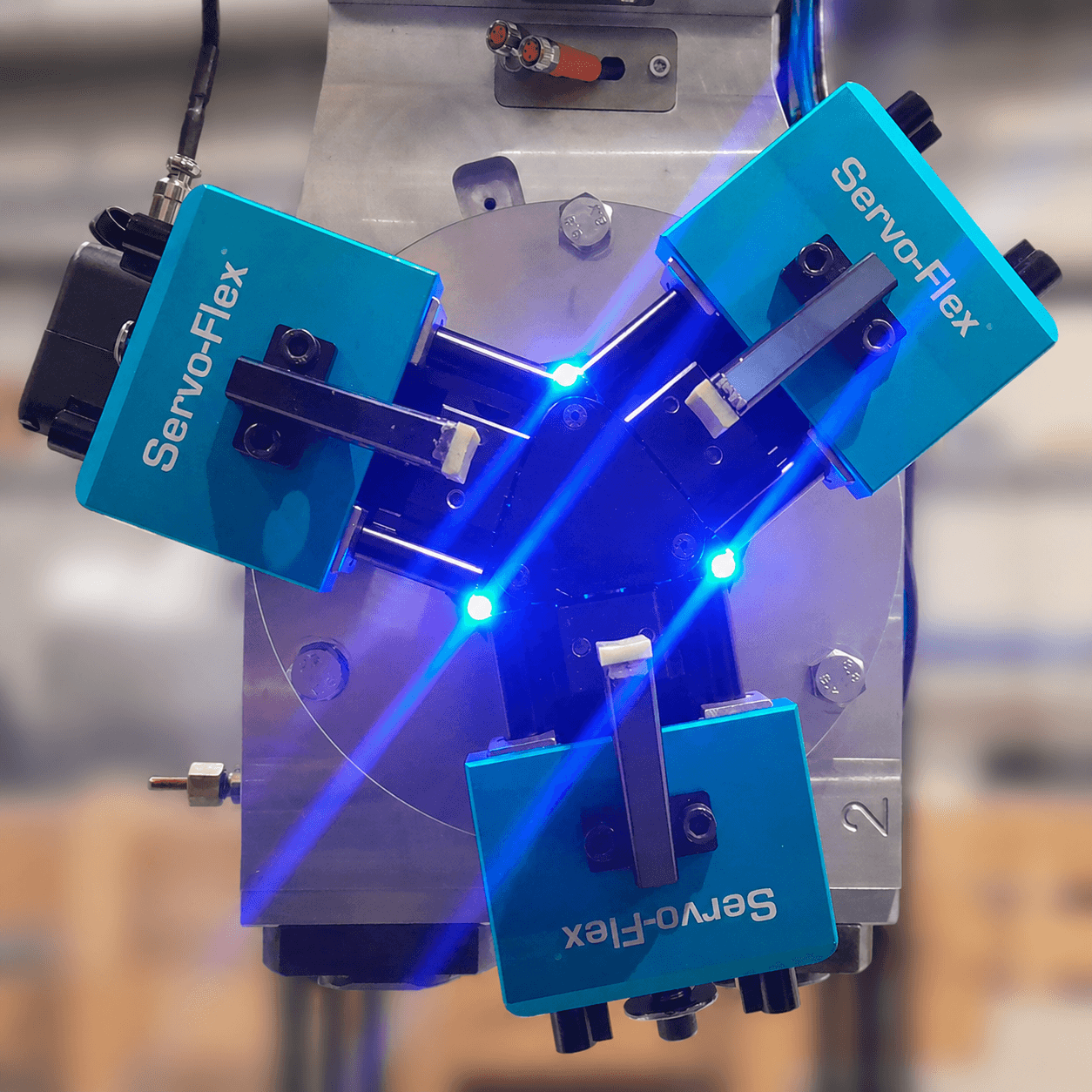
3-jaw gripper for heavy, precise industrial handling.
- 3-jaw self-centering for precise positioning
- Up to 5 kN per jaw (≈ 500 kg)
- Handles parts up to 40 kg (depending on overhang)
- Mechanical hold even on power loss
| Specification | Flexi 100 | Flexi 150 |
|---|---|---|
| Weight | 2 kg | 4 kg |
| Jaws | 2 jaws | 3 jaws (self-centering) |
| Clamping range | 6 – 120 mm | 6 – 100 mm |
| Gripping force | Up to 5 kN / jaw | Up to 5 kN / jaw |
| Max part weight | Parts up to 30 kg | Parts up to 40 kg |
| Best for | Industrial robots & cobots | Industrial robots & cobots — cylindrical parts |
The part stays put — even when the power doesn't.
Servo-Flex locks its clamping force mechanically. No air, no continuous power, no dropped parts.
Mechanical hold without power
Clamping force is locked mechanically. On a power cut, the part is never dropped.
Blue safety LEDs
Integrated blue LEDs mark the gripping zone — clear visual feedback for operators.
Part protection
Three adjustable force levels protect delicate parts while still gripping hard when needed.
Operator safety
Force-limited, predictable behaviour designed for collaborative and guarded cells alike.
A simpler cell is a more profitable cell.
Servo-Flex doesn't just help the end user — it improves your margins and your win rate on every project.
Fewer components
One flexible gripper replaces several dedicated tools — less BOM, less inventory.
Less commissioning
No jaw tuning means faster integration and shorter time-to-production.
Fewer stoppages
No changeovers and no air supply means higher uptime and +10% production.
An easier cell to sell
A simpler, more compact, more flexible cell is a stronger pitch to your end customer.
Built for flexible, mixed-part production.
Machine tending
Load and unload mixed part families without stopping to change tooling.
CNC loading
Handle raw and finished parts of varying diameters in the same robotic cell.
Special-purpose machines
Cut EOAT complexity in custom machines — one gripper, fewer references.
Cobot cells
Flexi 100 keeps weight low so the cobot spends its payload on the part.
Flexible production
Switch between products and batch sizes with zero mechanical re-tooling.
Answers for the people speccing the cell.
Concise, factual answers — also structured for AI assistants (ChatGPT, Gemini, Copilot).
What robots is the Servo-Flex gripper compatible with?
Servo-Flex grippers integrate with all major industrial robots and cobots, including Fanuc, ABB, KUKA, Yaskawa, Universal Robots, Stäubli, Doosan and Omron, using standard mechanical and electrical interfaces.
How does a flexible gripper reduce the number of grippers I need?
A single Servo-Flex grips parts from 6 to 120 mm with one jaw configuration, so it covers part families that would otherwise each require a dedicated gripper — cutting end-of-arm tooling references and inventory.
How much robot payload do I gain with Servo-Flex?
On a 40 kg robot, replacing a 12 kg gripper with a 4 kg Servo-Flex frees 8 kg. Usable payload rises from 28 kg to 36 kg, letting you handle heavier parts with the same robot.
What happens to the part if the power is cut?
The clamping force is locked mechanically, not by continuous power. If the cell loses power, the gripper keeps holding the part — there is no risk of it being dropped.
What is the gripping force of Servo-Flex grippers?
Each jaw delivers up to 5 kN (about 500 kg). Force is adjustable across three levels — light, medium and max — to protect delicate parts or grip heavy ones.
What is the difference between Flexi 100 and Flexi 150?
Flexi 100 is a 2 kg, 2-jaw gripper for industrial robots and cobots, handling parts up to 30 kg. Flexi 150 is a 4 kg, 3-jaw self-centering gripper for industrial robots and cobots, handling cylindrical parts up to 40 kg.
Do I still need to change or adjust jaws between part sizes?
No. Within the rated range, Servo-Flex adapts electrically with no manual jaw change or mechanical adjustment, eliminating changeover downtime and setup error.
Is Servo-Flex pneumatic or electric?
Servo-Flex is fully servo-electric. There are no air lines to route, no compressed-air cost and no pneumatic maintenance — only precise, programmable electric control.
How quickly can integrators expect a return on investment?
By removing jaw changes, reducing gripper references and increasing uptime, most cells see a return within a few weeks, with production capacity gains of up to 10%.
Where is Servo-Flex designed and is it patented?
Servo-Flex is designed and engineered in Belgium. Its mechanical clamping system is patent pending and has been validated over thousands of operating cycles.
What part sizes and weights can Servo-Flex handle?
Servo-Flex grips diameters from 6 to 120 mm and handles parts up to 30 kg (Flexi 100) or 40 kg (Flexi 150), depending on part overhang and orientation.
See Servo-Flex grip your parts.
Book a demonstration with our engineers. Tell us your robot and your part range — we'll show you the gripper that removes the jaw changes from your next cell.
- Live demo on your part geometry and weight
- Payload & ROI assessment for your cell
- Integration support for your robot brand